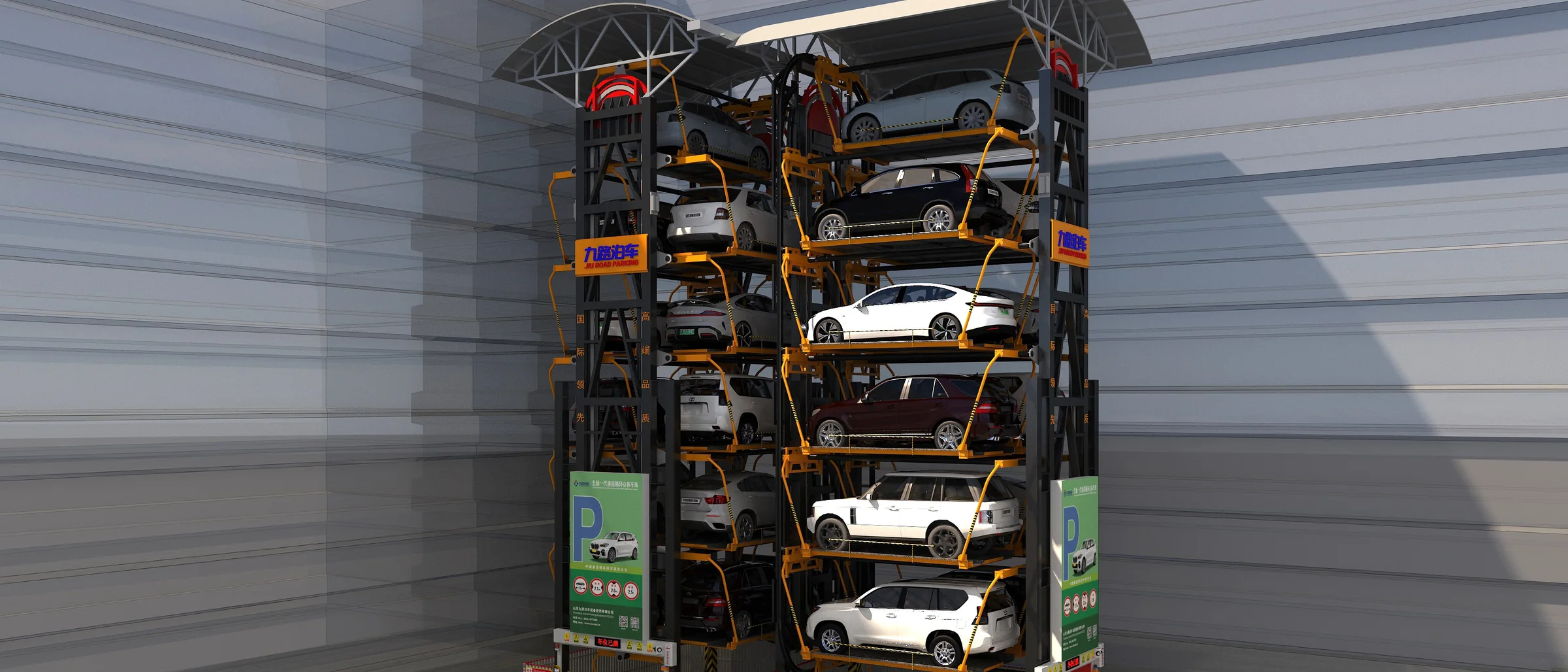
The short answer
For most tight city plots, a rotary tower is the right call: 8 to 22 cars on the footprint of roughly two, as long as planning lets you build up. Puzzle parking earns its place on wide, low sites with a strict height cap, usually two to six levels, with every car able to come out on its own. A stacker is the budget fix. It doubles or triples a single bay for people who park in the same spot every day.
We build rotary towers, so you’d expect us to say that. Check it yourself: the worked example further down has one supplier’s numbers for both systems on the same plot.
Under the hood, all three move a steel platform so nobody has to hunt for a space. What differs is the direction that platform travels.
How each system works
Rotary: a loop that goes up
A rotary system goes by a few names: vertical rotary, carousel, paternoster. The pallets hang from a chain loop that runs up one side of the tower and down the other, a bit like a Ferris wheel squeezed flat. To bring your car down, the whole loop turns until your pallet reaches the entry level. All the machinery goes upward, so you add capacity by adding height, and the footprint stays at about two cars.
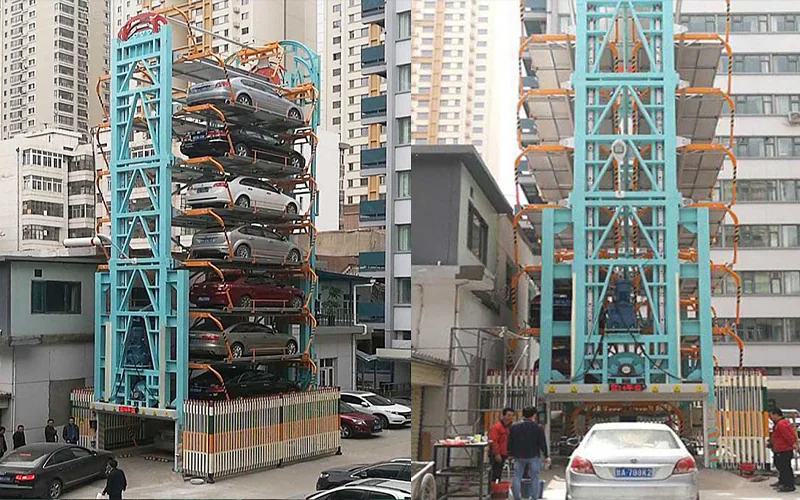
Gansu Academy of Mechanical Sciences, China
Stackers
A stacker is essentially a car lift. One platform goes up so a second car fits underneath, which turns one bay into two, or occasionally three. The basic dependent type has a catch: the bottom car has to come out before the top one can come down. That’s fine for a family or a small office where people can sort it out between themselves. Independent stackers fix it with a pit below ground, so either car can leave without the other one moving.
Puzzle parking
Puzzle parking, which you’ll also hear called lift-and-slide or semi-automatic, works like one of those sliding tile puzzles. Pallets sit in a grid of columns and levels, and every level below the top keeps one slot empty. When you ask for your car, the system shuffles pallets sideways into that gap until there’s a clear path, then lowers your car to the ground. Nobody else’s car has to move, which is why you see so many of these in apartment and office basements.
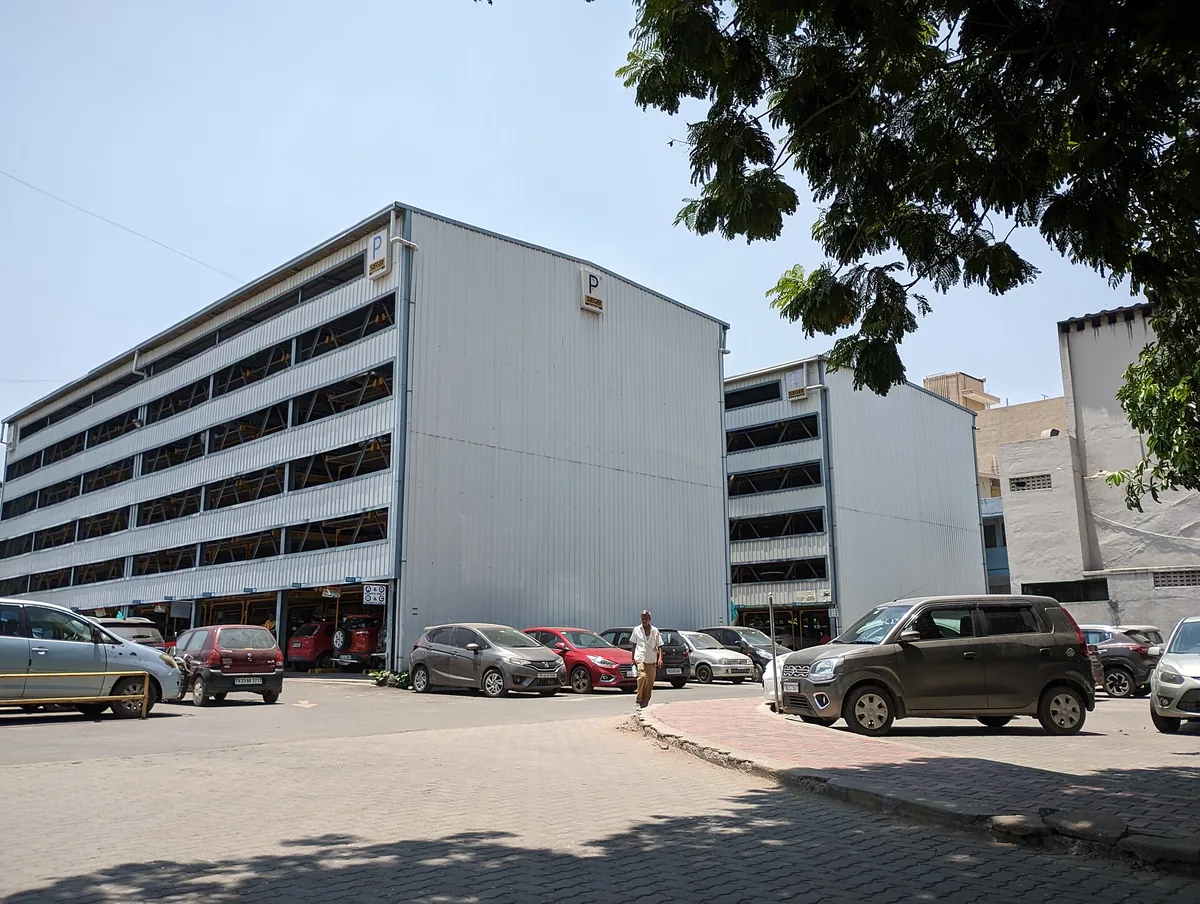
Vellore, Tamil Nadu, India
Side by side
| Rotary | Puzzle | Stacker | |
|---|---|---|---|
| Movement | Pallets circulate on a vertical loop | Horizontal slide plus vertical lift | Vertical lift |
| Typical height | 5 to 12 levels (AutoDock series) | Usually 2 to 6 levels | 2 to 3 levels |
| Cars per footprint | 8 to 22 on about 2 spaces | Levels × columns, minus one per lower level | 2 to 3 per bay |
| Access | Independent, through one entry bay per tower | Independent | Often dependent: the lower car moves first |
| Plot it suits | Small, narrow or awkward, height allowed | Wide or long, height-limited | Existing bays with headroom |
| Best for | Dense city plots, malls, hospitals, fleet depots | Apartment and office basements | Homes, assigned staff spaces |
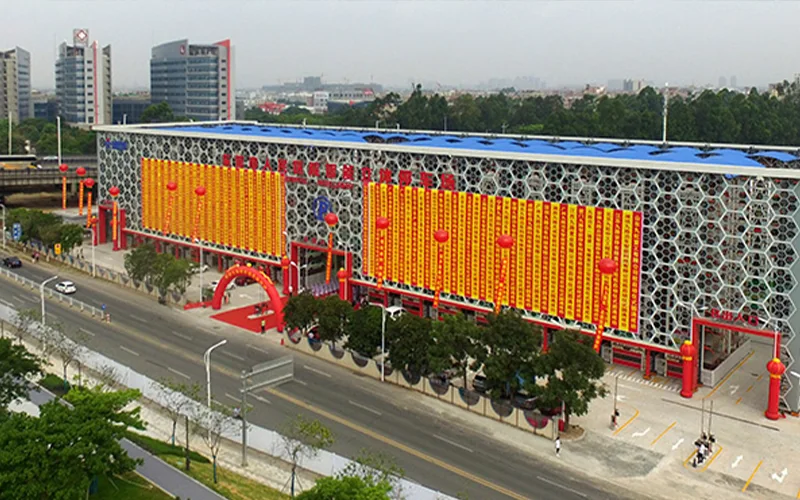
Dongguan People’s Hospital, China
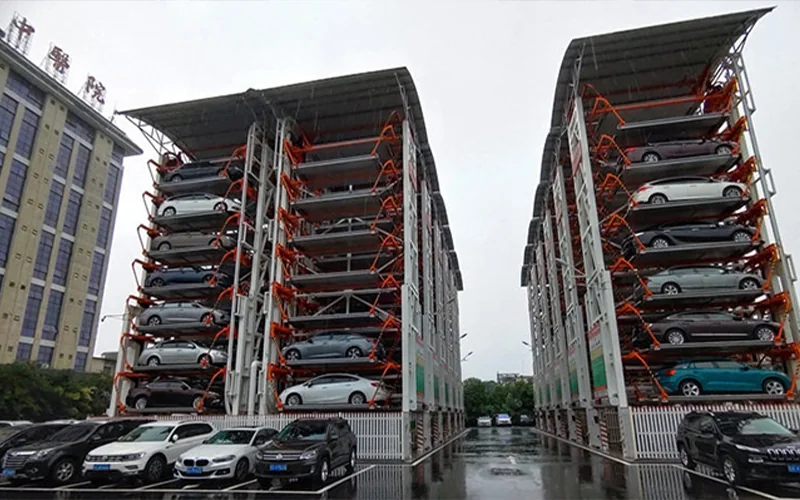
Anhui Lixin People’s Hospital, China
How many cars each one fits
Each system counts differently, and it’s worth running these numbers on your own plot before you speak to any supplier.
- Rotary: height does the work here. The AutoDock range goes from 5 levels with 8 cars up to 12 levels with 22, adding two spaces per level, all on the ground area of about two ordinary parking spaces. SUV-rated towers follow the same layouts up to 11 levels and 20 spaces.
- Stacker: bays × levels. Ten bays of two-level stackers gives you 20 cars.
- Puzzle: columns × levels, then take away one for each level below the top. Those empty slots are what let the grid move. Three levels across five columns gives 3 × 5 − 2 = 13 cars on a frontage five bays wide.
Try those on a plot that fits two or three cars at ground level and only the rotary number really moves. Puzzle grids need width, so on a wide, low site with a height cap one can come out ahead.
Rotary vs puzzle on the same plot
One Indian supplier laid out its own puzzle and rotary systems on the same 9,188 sq ft plot (about 854 m²) for a site study. Here’s what it found:
| Puzzle | Rotary | |
|---|---|---|
| Cars parked | 93 | 126 |
| Cars per machine | 31 | 14 |
| Motors | 153 | 9 |
| Sensors | 153 | 9 |
| Connected load | 257 kW | 135 kW |
| Retrieval: min / avg / max | 45 / 80 / 140 s | 30 / 60 / 120 s |
| Installation and commissioning | 120 days, heavy civil work | 60 days maximum, least civil work |
The headline is 33 more cars, about 35% more, from the same plot. For most owners that settles it.
The parts count matters nearly as much. A puzzle grid spreads its drives and sensors across the pallets, which is how this one ended up with 153 motors for 93 cars, against 9 for the rotary layout’s 126. Every motor is something to inspect, service and eventually replace, and one more way for a car to get stuck. Fewer of them also cuts the connected load from 257 kW to 135 kW, leaving room on the same supply for EV chargers.
Rotary was quicker to retrieve at every point the study measured, and with much less civil work it was installed and commissioned in half the time. Drivers notice the difference too: they pull onto an open, guided pallet at one entry bay instead of squeezing into a slot between steel columns.
These are one supplier’s figures for its own equipment, so your site will come out differently. We’d expect the same pattern. AutoDock towers also have manual retrieval for power cuts, and they don’t need a building around them.
Choosing for your plot
Start with the plot, not the brochure. If it’s small, narrow or an odd shape and you need far more cars than the ground will take, look at rotary first. What decides it is how many levels planning will allow, not how many a tower can reach. Each tower stands on its own, so one can go into a leftover corner and three can go in a row.
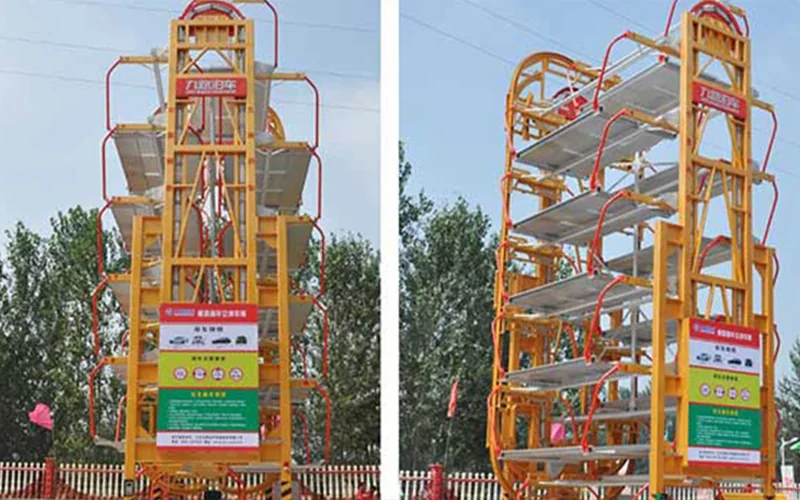
National Bank of Dubai, UAE
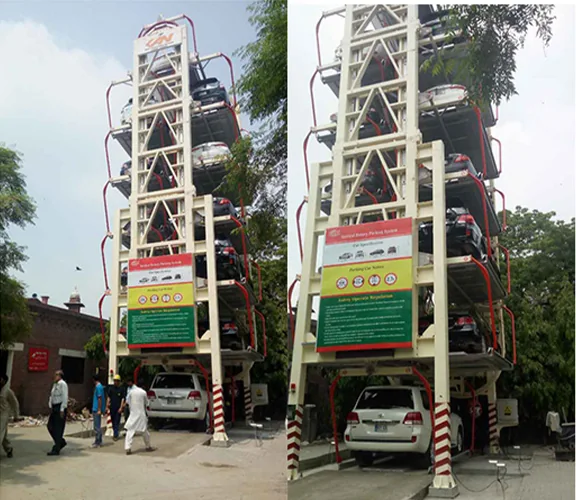
Pakistan
Bigger sites take towers in groups. Each one has its own entry bay, so several load at the same time. In one layout the manufacturer publishes, 53 sets providing 1,008 parking spaces complete all inbound and outbound operations within half an hour during rush hours. There are more of the manufacturer’s installations on our technology page.
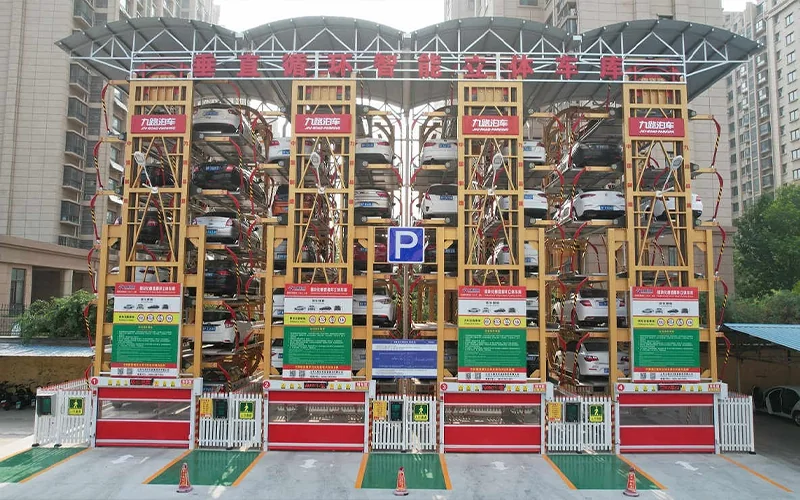
Gaotang County Government Affairs Service Center, China
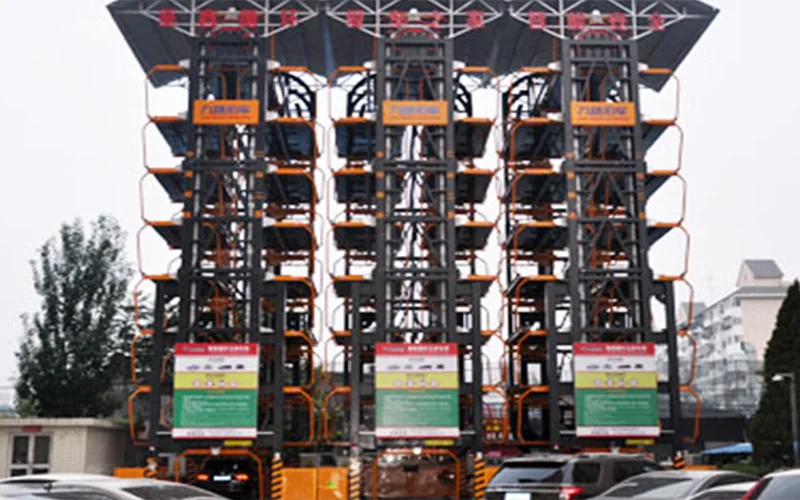
Beijing Baita’an Open University, China
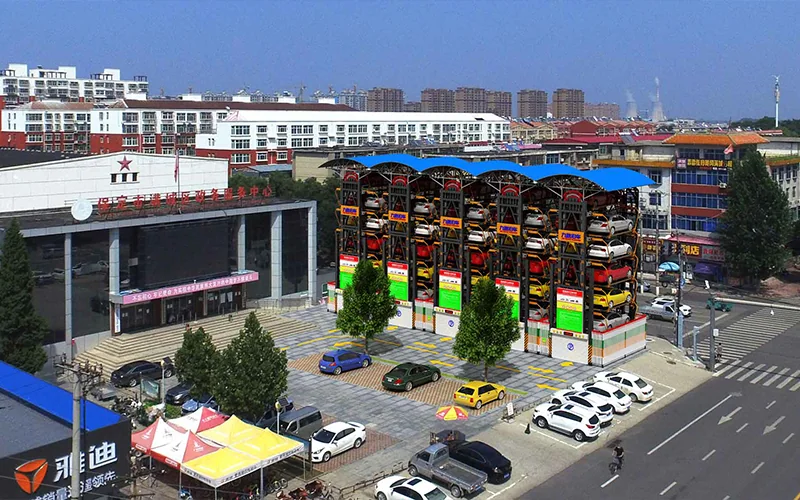
Mancheng District Administrative Service Center, Baoding, China
Puzzle parking makes sense when the site is wide or long and a height cap rules a tower out. You lose one slot on each lower level so the grid can move. In return, lots of people can get their cars out without waiting on anyone else, which is why apartment basements use them.
A stacker is the cheap option. If the same few people park in the same bays every day, there’s headroom, and two or three cars per bay is plenty, it does the job.
If the cars are electric
EVs bring two practical problems: they’re heavy, and they need to stay plugged in.
On weight, a lot of commercial mechanical parking platforms are rated somewhere between 2,000 and 2,500 kg. That rules out plenty of SUVs and EVs. Every AutoDock platform is rated to 3,500 kg, so one tower takes a mixed fleet and nobody has to keep particular bays for particular cars.
Charging is trickier. The car sits on a platform that moves, so the charger has to move with it. Ask suppliers straight out whether charging carries on while the system runs. In our towers every bay has its own AC fast charger, and the manufacturer’s CHARPARKING system keeps cars charging whether the tower is turning or not. Details are on the systems page.
What to ask any supplier
Whatever ends up on your shortlist, ask these:
- Payload per platform, in kilograms, and which of your vehicles it rules out.
- Retrieval time to the furthest position, measured with the system fully loaded, not an average. For rotary systems, industry figures usually fall between 60 and 120 seconds.
- Structure and corrosion protection: what grade of steel, and whether it’s galvanised or just painted.
- Controls and safety: a programmable logic controller, and which safety interlocks are standard rather than paid extras.
- Installation time and warranty: how long your site will be a construction site, and what’s covered, for how long.
Our FAQ covers each of these in more depth. And if you already have a plot in mind, send us its dimensions and how many cars you need. We’ll tell you which system fits and how many it would hold.